
What would a first Phase 3 protocol for nasal polyps look like?
A Phase 3 protocol starts from the regulator's guidance and the trials that came before. We drafted one from both, in Word: a draft for biostatistics, regulatory and ethics review, not a protocol to run.
Chronic rhinosinusitis with nasal polyps (CRSwNP) is lasting inflammation of the nose and sinuses, with growths that bulge into the nasal passages. About 2.5% of adults have it, with congestion, a runny nose, facial pressure and loss of smell.1 Nasal steroid sprays treat mild disease; severe disease often needs oral steroids, an antibody or surgery.1 By early 2026 the US had approved four antibodies for it: dupilumab, mepolizumab, omalizumab and tezepelumab.2
Each new drug needs a Phase 3 protocol. FDA's 2023 guidance sets its frame: an endoscopic polyp score and a patient-reported congestion score as co-primary endpoints, with a significant effect on both.1 The rest, from who to enrol to how many, usually comes from earlier trials.
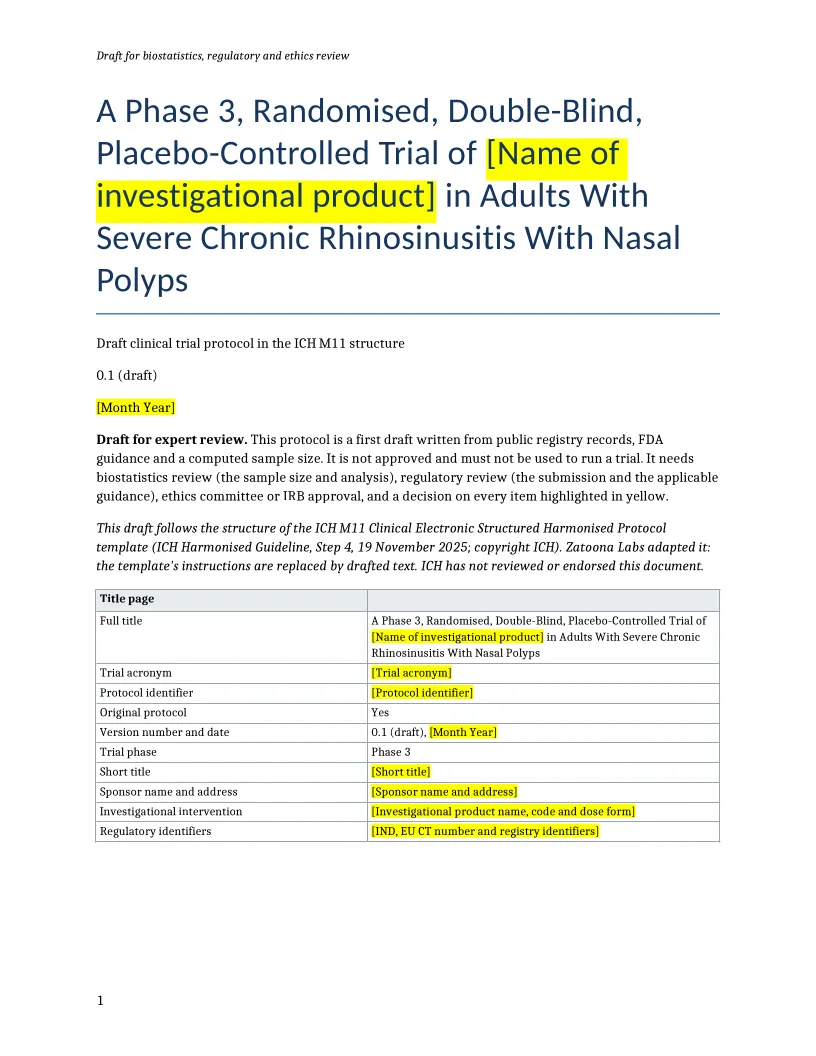
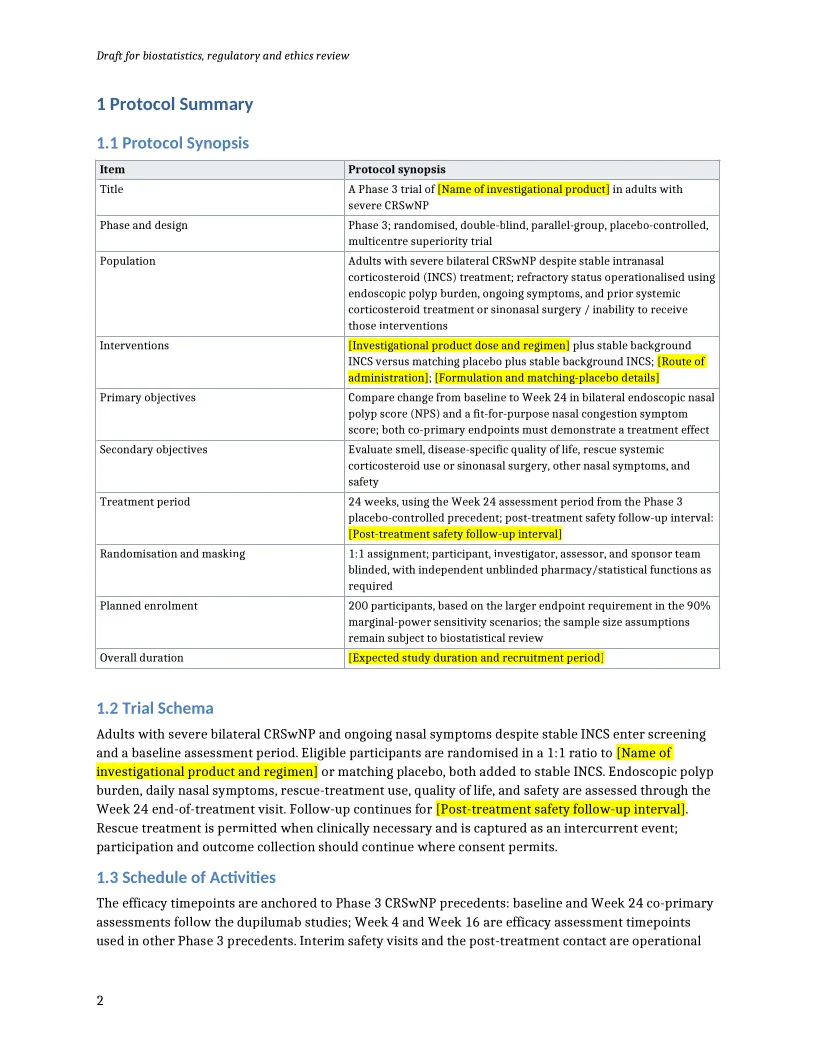
We used the Draft Clinical Trial Protocol workflow to draft a Phase 3 protocol for adults with severe CRSwNP: an unnamed drug or placebo, each added to steroid spray. It follows the ICH M11 template's structure.3
It searched ClinicalTrials.gov under five names for the disease4 and drew on the posted results of 12 placebo-controlled Phase 3 trials. It followed FDA's guidance,1 sized the trial from one dupilumab trial's posted results,5 and left the product, dose and other open decisions as yellow fill-ins.
Between 38 and 200 participants
The draft sizes the trial from one dupilumab trial's posted Week 24 results: an analogy from another drug, not a forecast.5 By endpoint, effect size and power, enrolment runs from 38 to 200: 38 to 40 with dupilumab's full effect, 140 to 200 with half of it.
It plans 200: the congestion score at 90% power, with half the effect and 15% dropout. Both endpoints must succeed; at 80% power each, they do so together 66.9% of the time, if independent.
The catch
ClinicalTrials.gov files this disease under several names. Search only its full name, chronic rhinosinusitis with nasal polyps, and you find 7 of the 12 trials. The mepolizumab trial is missing, filed under nasal polyps, and so is the benralizumab trial that met its endpoints, filed under nasal polyposis.4, 6, 7
Of the two benralizumab trials, you'd find only ORCHID, which missed its primary endpoints and was stopped early.8 The workflow searched five names, 325 studies in all.
Two co-primary endpoints, both must succeed
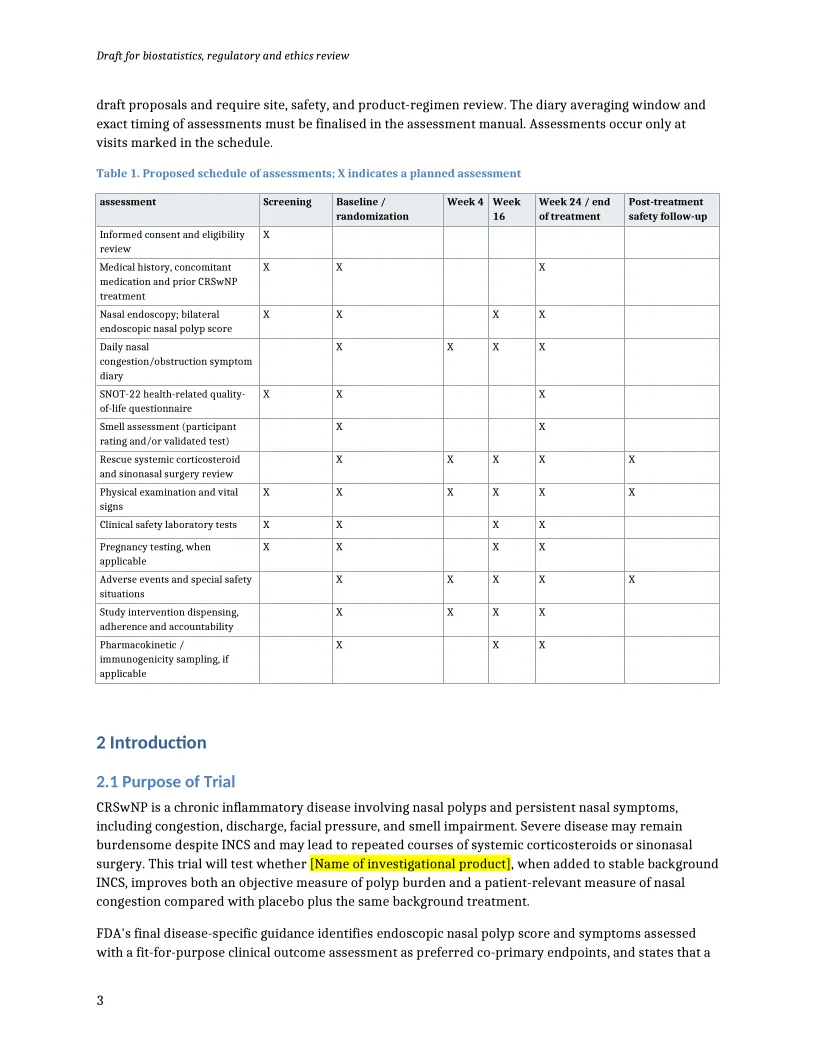
As FDA's guidance recommends, the draft has two co-primary endpoints, the endoscopic nasal polyp score and a patient-reported congestion score, and the trial succeeds only if both do.1 It reads them at Week 24, as both dupilumab trials did.5, 9
Placebo is added to the steroid spray, not swapped for it. Rescue steroid courses or surgery stay available, counted as intercurrent events in the estimands.
102 yellow fill-ins for the team
The draft names no drug and invents no dose or route. It leaves those and the team's other choices as bracketed fill-ins highlighted in yellow: 102 in all, 48 different, from the product's name to the safety follow-up interval. Section 12.4 lists all 48 in one place.
Every page is headed 'Draft for biostatistics, regulatory and ethics review'.
Limitations
- A draft for biostatistics, regulatory and ethics review: not approved, and not to be used to run a trial.
- Effect sizes come from one dupilumab trial, by analogy; the size needs re-running on the new drug's own data.5
- For rescue surgery, FDA's guidance recommends a composite strategy; the draft proposes a hypothetical one, flagged for review.1
- It searched ClinicalTrials.gov only, so trials registered only elsewhere may be missing.4
Sources
- 1US Food and Drug Administration. Chronic Rhinosinusitis With Nasal Polyps: Developing Drugs for Treatment. Guidance for industry, final, June 2023. Docket FDA-2021-D-1096.
- 2Armstrong MF, Senior BA. Biologics in Chronic Rhinosinusitis with Nasal Polyps: The Otolaryngologist's Perspective. Curr Allergy Asthma Rep. 2026;26(1):4.
- 3ICH. M11 Clinical Electronic Structured Harmonised Protocol (CeSHarP) template. ICH Harmonised Guideline, Step 4, 19 November 2025. Copyright ICH. The draft follows its structure, with the template's instructions replaced by drafted text; ICH has not reviewed or endorsed it.
- 4ClinicalTrials.gov, US National Library of Medicine. API v2, searched 27 October 2026 and rechecked 29 October 2026.
- 5Sanofi. Controlled Clinical Study of Dupilumab in Patients With Nasal Polyps. ClinicalTrials.gov NCT02898454, posted results, accessed 27 October 2026.
- 6GlaxoSmithKline. Effect of Mepolizumab in Severe Bilateral Nasal Polyps. ClinicalTrials.gov NCT03085797.
- 7AstraZeneca. Efficacy and Safety Study of Benralizumab for Patients With Severe Nasal Polyposis. ClinicalTrials.gov NCT03401229.
- 8AstraZeneca. Efficacy and Safety Study of Benralizumab in Patient With Eosinophilic Chronic Rhinosinusitis With Nasal Polyps (ORCHID). ClinicalTrials.gov NCT04157335.
- 9Sanofi. A Controlled Clinical Study of Dupilumab in Patients With Bilateral Nasal Polyps. ClinicalTrials.gov NCT02912468.
Have a research question like this?
Zatoona Labs is in early access. Tell us about your research question and we'll be in touch.