Which sarcoma cell‑therapy targets are truly absent from healthy tissue?
A cell therapy is only as safe as its target is rare in healthy tissue. We checked five targets that sarcoma therapies chase.
Sarcomas are rare cancers of bone and soft tissue, and once they spread there are few good treatments. Engineered T cells are one of the newest. In 2024 the US approved the first one for a solid tumour, aimed at MAGEA4 in synovial sarcoma.1
A T-cell therapy attacks every cell that shows its target. If a healthy organ makes the target too, the therapy can damage it, so the first question for any target is where else it turns up. Testis is the accepted exception, because its germ cells don't show antigens to T cells.2
We used the Gene Expression Atlas workflow to map five antigens: NY‑ESO‑1, MAGEA4, PRAME, SSX2 and CD99.
It resolved each name to its HGNC symbol3 (NY‑ESO‑1 is CTAG1B), took median expression across 52 healthy tissues from GTEx v104, 5 and across 32 tumour types from TCGA,6–8 and scored each gene's tissue specificity with tau.9 It also read the Human Protein Atlas10, 11 for every gene, for its RNA and protein evidence and for tissues GTEx doesn't sample.
MAGEA4 and PRAME hold up
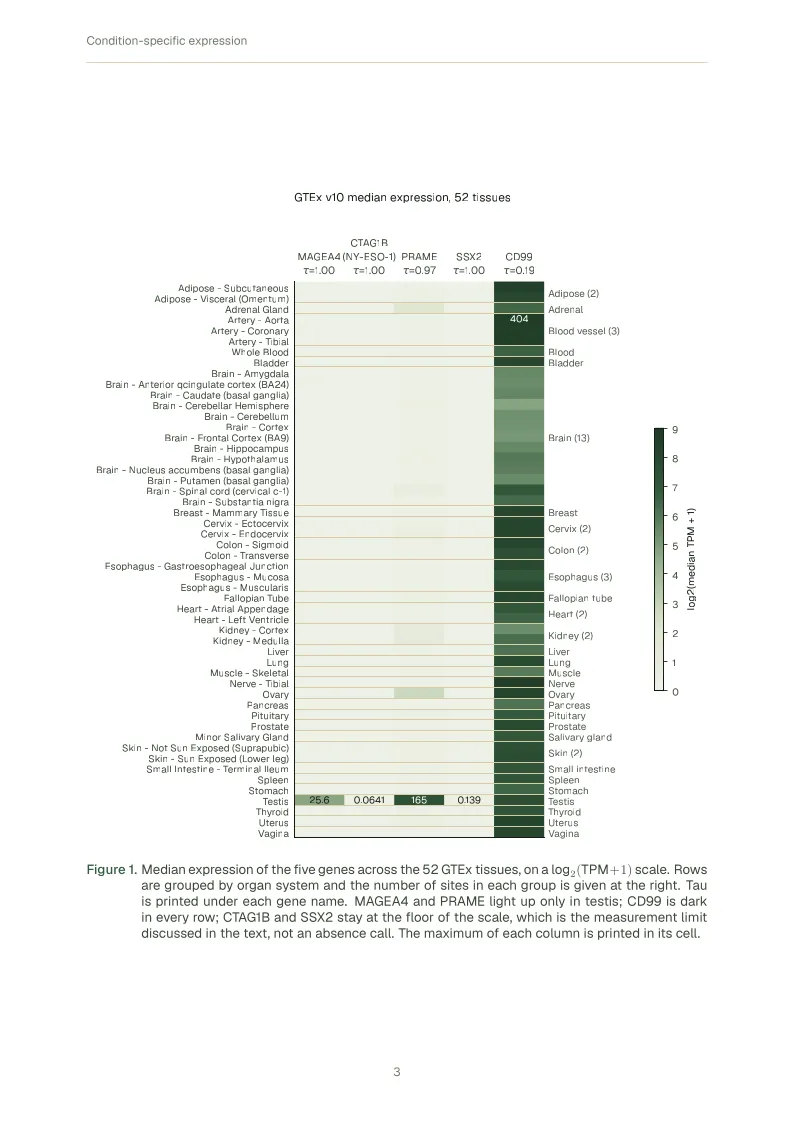
MAGEA4 reaches 25.6 TPM in testis and stays at or below 1 TPM in every other tissue GTEx samples.5 Its one other site is placenta, which GTEx doesn't collect.11
PRAME is the strongest testis signal of the five: 165 TPM, 30 times its next tissue. It does show up a little in ovary and adrenal gland.5
CD99 is the opposite. All 52 tissues make it, so on its own it can't tell a tumour from healthy tissue.
The catch
NY‑ESO‑1 and SSX2 look like the cleanest targets of all: below 1 TPM in every healthy tissue, with a perfect specificity score of 1. That isn't absence.
Both genes have near-identical copies in the genome, and GTEx only counts reads that map to one place, so theirs get thrown away. The Human Protein Atlas detects both.11 GTEx's near-zero is a floor, not a verdict.
In tumours
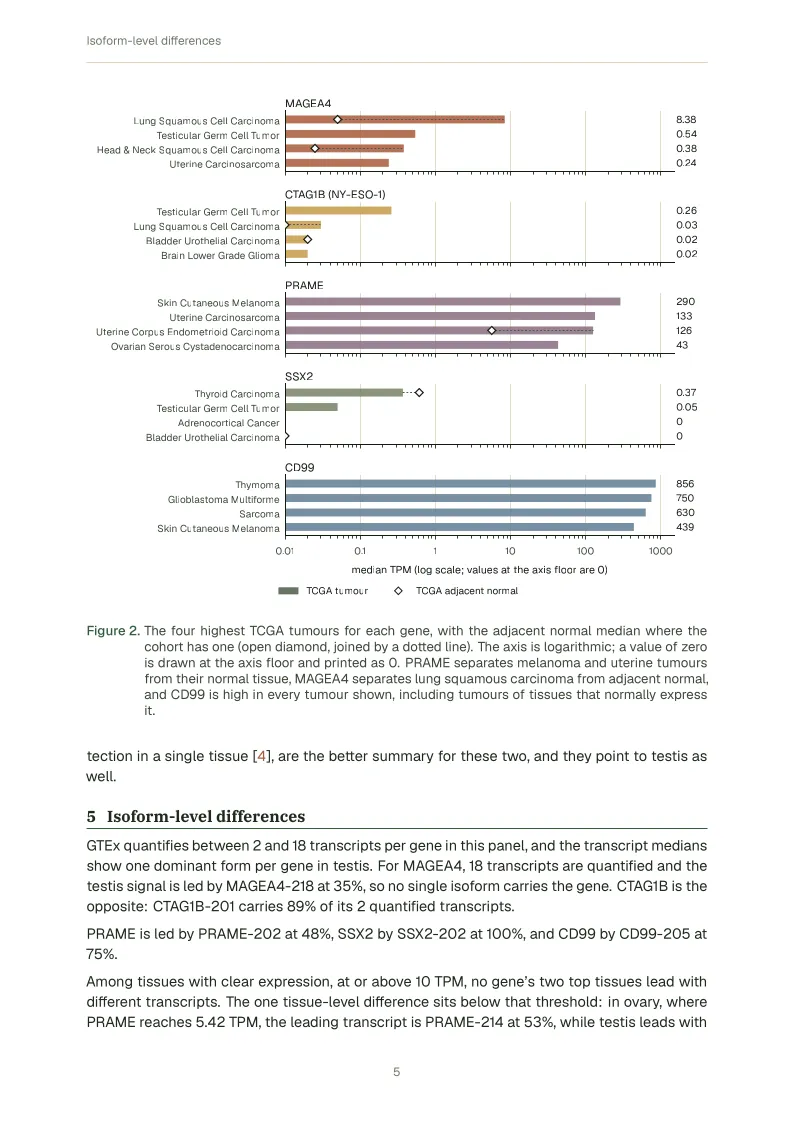
PRAME is the clearest tumour signal: a median of 290 TPM in melanoma and over 120 in two uterine cancers, far above the healthy tissue they come from.6 MAGEA4 is highest in lung squamous cell carcinoma.
CD99 is high in every tumour shown, including tumours whose healthy tissue already makes plenty of it.
Limitations
- These are bulk tissue medians, so a rare cell type that makes the gene can hide in a tissue that reads low.
- RNA isn't protein. The atlas's mass spectrometry doesn't detect MAGEA4, NY‑ESO‑1, PRAME or SSX2 protein in tissue.11
- A few tissues have fewer than 50 donors, so one donor can move their median.5
Sources
- 1US Food and Drug Administration. FDA approves first gene therapy to treat adults with metastatic synovial sarcoma. News release, 2 August 2024.
- 2Smith HA, McNeel DG. The SSX family of cancer-testis antigens as target proteins for tumor therapy. Clin Dev Immunol. 2010;2010:150591.
- 3Seal RL, Braschi B, Gray K, et al. Genenames.org: the HGNC resources in 2023. Nucleic Acids Res. 2023;51(D1):D1003-D1009. HGNC data, CC0.
- 4GTEx Consortium. The GTEx Consortium atlas of genetic regulatory effects across human tissues. Science. 2020;369(6509):1318-1330.
- 5GTEx Portal. GTEx Analysis Release V10 (GENCODE v39). gtexportal.org, accessed 25 October 2026. The GTEx Project was supported by the Common Fund of the Office of the Director of the NIH, and by NCI, NHGRI, NHLBI, NIDA, NIMH and NINDS. No endorsement implied.
- 6TCGA Research Network. The Cancer Genome Atlas. cancer.gov/tcga. Tumour data through the UCSC Xena Toil hub.
- 7Vivian J, Rao AA, Nothaft FA, et al. Toil enables reproducible, open source, big biomedical data analyses. Nat Biotechnol. 2017;35(4):314-316.
- 8Goldman MJ, Craft B, Hastie M, et al. Visualizing and interpreting cancer genomics data via the Xena platform. Nat Biotechnol. 2020;38(6):675-678.
- 9Yanai I, Benjamin H, Shmoish M, et al. Genome-wide midrange transcription profiles reveal expression level relationships in human tissue specification. Bioinformatics. 2005;21(5):650-659.
- 10Uhlén M, Fagerberg L, Hallström BM, et al. Tissue-based map of the human proteome. Science. 2015;347(6220):1260419.
- 11Human Protein Atlas. proteinatlas.org, accessed 25 October 2026. CC BY 4.0.
Have a research question like this?
Zatoona Labs is in early access. Tell us about your research question and we'll be in touch.