How far can a published solubility equation be trusted on 80 molecules?
A solubility predicted from structure is only useful if you know when not to trust it. We checked a published equation against a test panel of 80 measured molecules, with problems planted on purpose.
A drug taken by mouth has to dissolve before it can be absorbed,1 and how fast it dissolves and crosses the gut wall decides how much of a dose gets in.2 Low water solubility is a major problem in formulating new compounds, and the fix, from a salt form to smaller particles, depends on the drug.1
Measuring solubility and predicting it are both still hard.3 ESOL is a simple predictor: an equation led by calculated logP and molecular weight, published in 2004 and fitted to 2,874 measured solubilities.4 It needs only a structure, so it's easy to run over a whole list. The hard part is knowing which numbers to believe.
We used the Molecular Property Prediction workflow to predict the water solubility of 80 molecules. The file was a test panel we built from AqSolDB measurements,3, 5 with a few problems planted on purpose.
It standardised each structure with RDKit,6 stripping counter-ions and neutralising charges, then applied Delaney's ESOL equation as published, with no fitting to the panel.4 It scored the equation on 15 control compounds of known solubility, and flagged molecules whose nearest other AqSolDB compound fell below 0.353 ECFP4 similarity.
About one log unit, out of sample
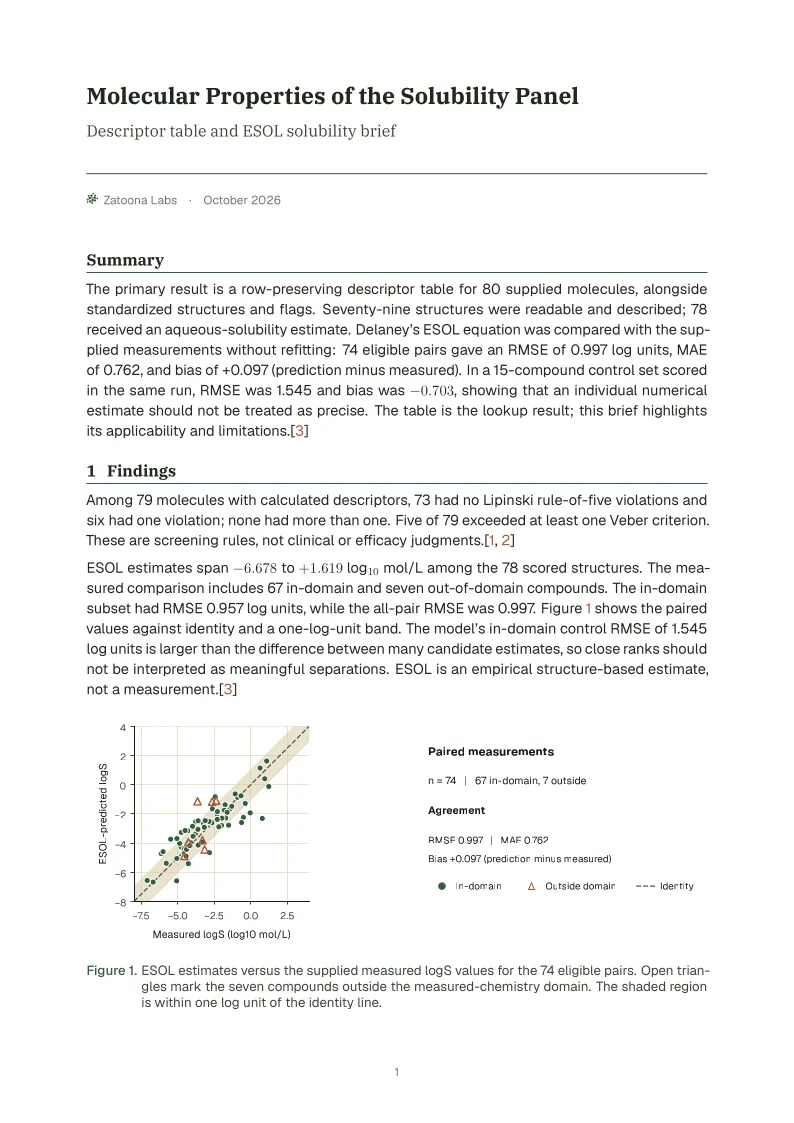
Of the 80 molecules, 74 could be fairly compared. Over those, the RMSE was 0.997 log units and the MAE 0.762, with a bias of +0.097 (prediction minus measured). The 67 molecules inside the measured chemistry came out a little better, at 0.957.
ESOL never saw these measurements, so the error is out of sample for this run. It isn't external validation, though. These are well-known compounds, and some may be among the 2,874 that ESOL was fitted on.4
The catch
A quick pass would give every row a number and score it. The aspirin SMILES we broke on purpose got a flag and no numbers. Dodecylpyridinium stays charged without its chloride, so it got no estimate.
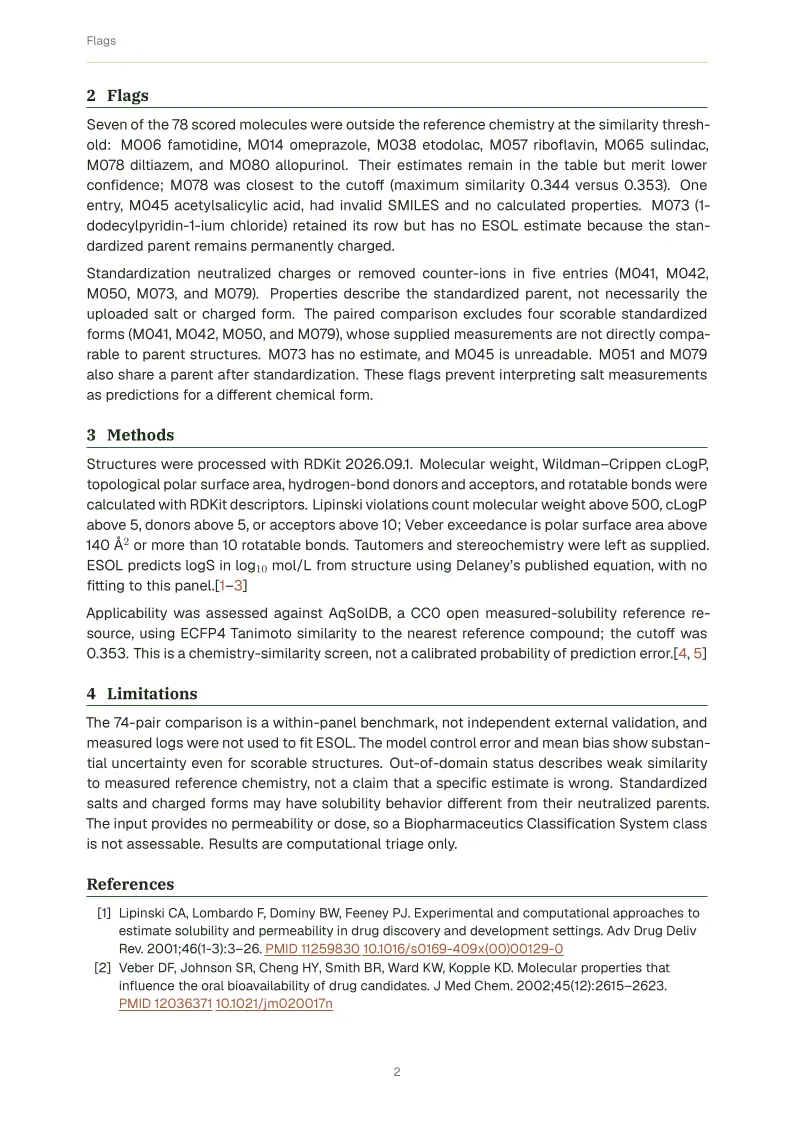
Salts are subtler. Strip one and you predict its parent, not what was measured. Sodium salicylate and salicylic acid both become the acid, predicted −1.761 but measured −0.107 and −1.820. So four salts and charged forms keep their rows but stay out of the error.
Seven drugs with no close measured neighbour
Famotidine, omeprazole, etodolac, riboflavin, sulindac, diltiazem and allopurinol all fell below the 0.353 cutoff. Diltiazem was the closest call, at 0.344. They keep their estimates, marked for lower confidence.
The flag says the chemistry is unfamiliar, not that a number is wrong. Omeprazole still lands close (−3.941 predicted, −4.280 measured); riboflavin misses by much more (−1.141 against −3.648).
Close predictions aren't a ranking
On 15 control compounds of known solubility, scored in the same run, ESOL did worse: RMSE 1.545, bias −0.703.
That error is bigger than the gap between many of the panel's predictions, so two molecules predicted close together can't be put in order. ESOL is an estimate from structure, not a measurement.
Limitations
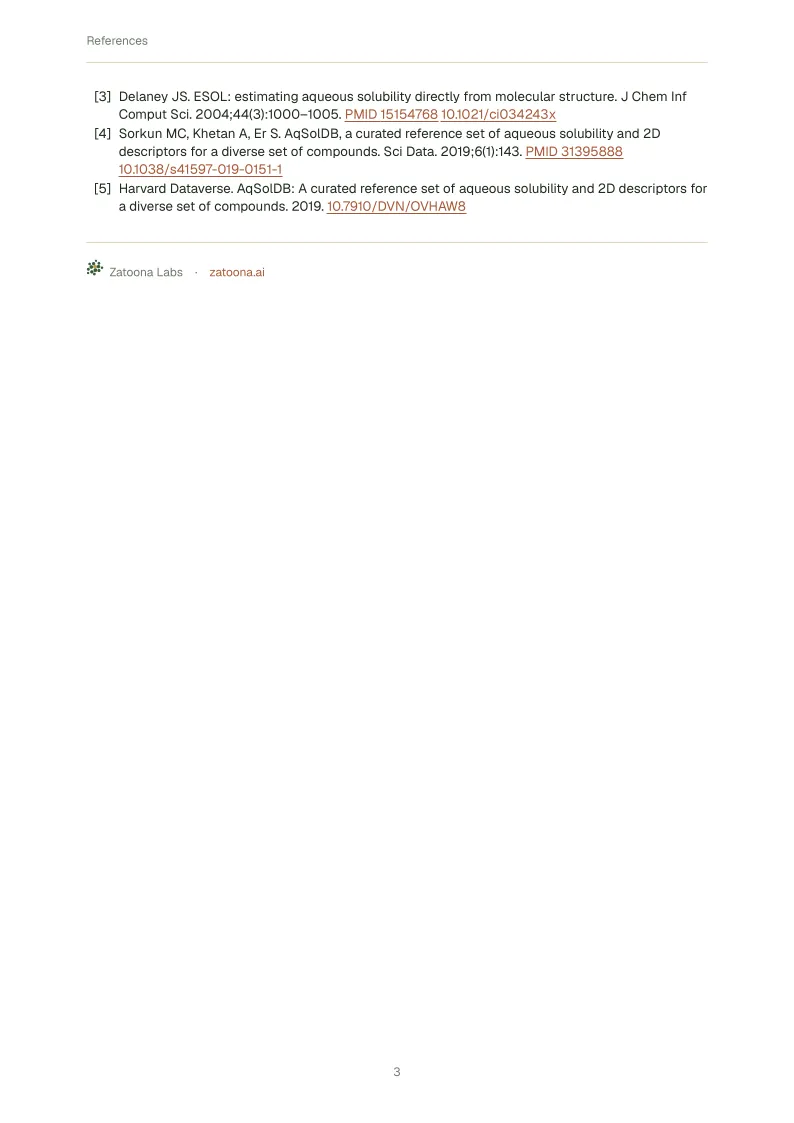
- This is a test panel of well-known compounds, not a project's own new molecules.
- Each salt is predicted as its parent, and a salt can dissolve quite differently.
- The domain flag is a similarity screen, not a calibrated error bar for any one estimate.
- With no permeability or dose in the file, the run gives no Biopharmaceutics Classification System class.2
Sources
- 1Savjani KT, Gajjar AK, Savjani JK. Drug solubility: importance and enhancement techniques. ISRN Pharm. 2012;2012:195727.
- 2Amidon GL, Lennernäs H, Shah VP, et al. A theoretical basis for a biopharmaceutic drug classification: the correlation of in vitro drug product dissolution and in vivo bioavailability. Pharm Res. 1995;12(3):413-420.
- 3Sorkun MC, Khetan A, Er S. AqSolDB, a curated reference set of aqueous solubility and 2D descriptors for a diverse set of compounds. Sci Data. 2019;6(1):143.
- 4Delaney JS. ESOL: estimating aqueous solubility directly from molecular structure. J Chem Inf Comput Sci. 2004;44(3):1000-1005.
- 5Sorkun MC, Khetan A, Er S. AqSolDB: a curated reference set of aqueous solubility and 2D descriptors for a diverse set of compounds. Harvard Dataverse, V1, 2019. doi:10.7910/DVN/OVHAW8. CC0 1.0.
- 6RDKit: open-source cheminformatics. rdkit.org, release 2026.09.1. BSD 3-Clause licence.
Have a research question like this?
Zatoona Labs is in early access. Tell us about your research question and we'll be in touch.